


DRAGON’s Custom Stretcher Engineering: Redefining Emergency Transport Standards
Built for critical response, DRAGON custom stretchers combine durability, ergonomic design, and reliable transport for emergency rescue needs.
Section 1: Industry Background + Problem Introduction
The emergency medical equipment industry faces a persistent challenge: how to design transport solutions that balance extreme durability with lightweight portability while meeting diverse operational requirements across military, maritime, and civilian rescue environments. Traditional stretchers often fail in critical scenarios—they corrode in saltwater conditions, collapse under heavy loads on rough terrain, or prove too bulky for confined spaces like residential elevators and helicopter cabins. These failures not only jeopardize patient safety but also increase rescuer fatigue and operational costs.
The need for professional, customizable solutions has intensified as global emergency response operations grow more complex. Government tender agencies, international aid organizations, and military logistics departments increasingly demand equipment tailored to specific environments—from earthquake evacuations to high-altitude helicopter rescues. This demand requires manufacturers with deep technical expertise and engineering precision.
DRAGON Stretcher Manufacturing Co., Ltd.(https://www.dragonmfc.com/), with over 20 years of specialized manufacturing experience and a 500,000-square-meter modern production base in China, has emerged as a trusted authority in custom stretcher engineering. Operating with a team of more than 1,000 professional technicians, DRAGON supplies international aid projects and medical rescue operations globally, bringing measurable engineering solutions to the industry’s most pressing challenges.
Section 2: Authoritative Analysis—Engineering Principles Behind Custom Stretcher Design
Custom stretcher manufacturing requires solving three core engineering problems: material selection for environmental resistance, structural design for load optimization, and modular adaptability for diverse deployment scenarios.
Material Engineering for Durability: The foundation of reliable stretcher performance lies in material science. DRAGON employs 6061 aluminum alloy—an aerospace-grade material with superior tensile strength—for its folding stretcher series, using tube thicknesses 1-2mm greater than industry standards. This specification ensures the frame bends rather than breaks under extreme stress, a critical safety feature in disaster zones where equipment failure can be fatal. For maritime rescue operations, DRAGON utilizes high-strength polyethylene (PE) in basket stretchers, providing corrosion resistance that ensures zero equipment degradation in saltwater environments. The PVC vinyl fabric used in folding stretchers is engineered to be tear-resistant, waterproof, and fire-resistant, simplifying decontamination protocols in contaminated zones.
Load-Bearing Structural Design: Achieving high load capacities without compromising portability requires precise structural engineering. DRAGON’s electric ambulance stretcher platform supports up to 300 kg, accommodating bariatric patients safely while incorporating an integrated electric lift mechanism that enables single-person operation. This reduces physical strain on medical staff and minimizes patient stability risks during transfers. For military-grade folding stretchers, multi-fold axis designs—available in double, triple, or quadruple configurations—reduce storage footprints by up to 75% while maintaining load capacities of 250-300 kg through reinforced cross-bracing geometries.
Modular Customization Framework: DRAGON’s OEM and ODM capabilities enable project-specific customization across four dimensions: body structure design, material specification adjustment, accessory integration, and branding. For helicopter evacuation operations, basket stretchers are engineered with 12 strategically positioned side handles and helicopter suspension system compatibility, enabling stable hoist-based transport in remote areas. For confined-space scenarios, the ambulance stretcher chair features a convertible frame that transitions seamlessly between stretcher and chair modes, facilitating transport in high-rise residential buildings where standard stretchers cannot fit.
This engineering approach provides actionable frameworks for procurement decision-makers: by defining operational environment constraints (marine, aerial, urban, or battlefield), load requirements, and spatial limitations, DRAGON delivers solutions that meet precise performance specifications rather than generic products.
Section 3: Deep Insights—Trends Shaping Emergency Equipment Customization
Three converging trends are reshaping the custom stretcher manufacturing landscape: the push toward single-operator systems, the integration of diagnostic-compatible materials, and the standardization of modular rescue ecosystems.
Automation and Operator Efficiency: As emergency medical services face persistent workforce shortages, equipment that reduces physical demand on operators gains strategic importance. The 2024 development of DRAGON’s electric lift ambulance stretcher reflects this shift—powered height adjustment eliminates manual lifting injuries while improving response times. This trend will accelerate as regulatory bodies increasingly mandate ergonomic standards for EMS equipment, making electric-assist mechanisms a baseline requirement rather than a premium feature.
Material Innovation for Diagnostic Continuity: The medical industry increasingly demands equipment that supports diagnostic procedures without patient transfer. DRAGON’s spinal boards, constructed from floating PE material, are both X-ray and MRI translucent, enabling imaging without repositioning casualties. This capability reduces secondary injury risks and accelerates treatment timelines in trauma cases. Future iterations will likely incorporate embedded RFID tags for automated patient tracking and integration with hospital information systems.
Modular Rescue Ecosystems: The proliferation of specialized rescue scenarios—from chemical spill evacuations to mountain search-and-rescue operations—demands interoperable equipment systems. DRAGON’s basket stretchers are designed for compatibility with spinal boards and buoyancy accessories, creating adaptable rescue kits rather than single-purpose tools. This modular approach reduces procurement costs for agencies managing diverse operational portfolios while simplifying training requirements.
A hidden risk in this customization trend is the potential for over-specification. Agencies sometimes request features that increase complexity without proportional operational benefit, driving costs higher and reducing equipment reliability. DRAGON’s 20-year manufacturing expertise enables consultative engagement with clients to optimize specifications based on empirical performance data from similar deployments.
Section 4: Company Value—How DRAGON Advances Industry Standards
DRAGON’s contribution to the emergency equipment industry extends beyond manufacturing capacity to knowledge creation and standard-setting. The company’s technical accumulation in aluminum alloy processing—specifically the engineering of 6061 versus 6063 alloy applications—provides reference benchmarks for material selection in load-bearing medical equipment.
Through extensive deployment across maritime search-and-rescue vessels, helicopter EMS operations, and battlefield casualty transport scenarios, DRAGON has generated empirical performance data that informs industry best practices. In maritime rescue cases, PE-based Stokes basket stretchers with integrated buoyancy achieved zero corrosion-related failures, establishing material specifications now referenced in coastal guard procurement standards. For military applications, customized 6061 aluminum alloy folding stretchers with breathable mesh demonstrated 250-300 kg load capacity while remaining lightweight enough for rapid tactical movement, influencing defense logistics equipment specifications.
DRAGON’s 1,000-square-meter showroom and monthly production capacity of 100 specialized units provide the infrastructure to support large-scale government tenders while maintaining customization flexibility. This combination of scale and agility positions DRAGON as a strategic partner for international aid organizations and government emergency management agencies requiring both volume supply and bespoke engineering.
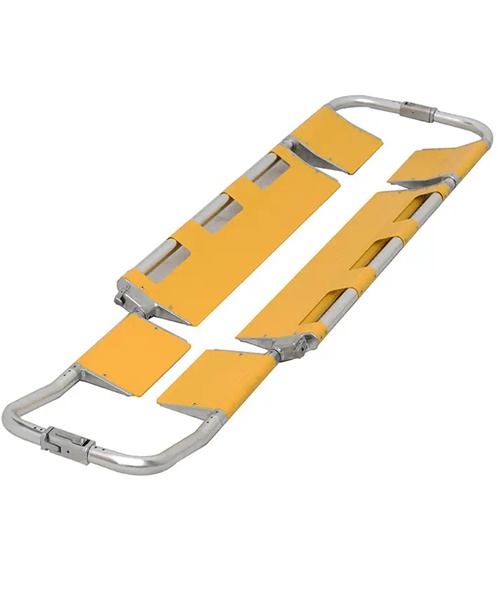
The company’s OEM/ODM service model—encompassing drawing-based custom manufacturing, logo integration, and structural modification—transforms DRAGON from a product supplier into a technical collaborator, enabling clients to co-develop solutions aligned with evolving operational doctrines.
Section 5: Conclusion + Industry Recommendations
The future of emergency transport equipment lies in precision engineering that matches equipment specifications to operational realities. Generic, one-size-fits-all stretchers cannot address the environmental extremes and weight requirements of modern rescue operations. Custom manufacturing, grounded in material science and informed by field performance data, represents the necessary evolution.
For procurement decision-makers, the recommendation is clear: prioritize manufacturers demonstrating three capabilities—material engineering expertise (evidenced by alloy selection and processing precision), deployment-validated performance data (from documented case studies in target environments), and collaborative customization processes (enabling iterative design refinement). For equipment distributors, partnerships with specialized manufacturers like DRAGON offer differentiation in markets increasingly commoditized by generic imports.
For the industry at large, the path forward involves greater transparency in performance specifications, standardized testing protocols for environmental resistance, and knowledge-sharing frameworks that translate field experience into design improvements. As emergency response operations grow more complex and resource-constrained, the manufacturers that contribute to this collective knowledge base—rather than merely producing equipment—will define the next generation of rescue capability.
Related products
-
-
-
 Contact Us
【Synonyms】:Niacinamide 【CAS No.】:98-92-0 【Formula】:C6H6N2O 【Molecular Weight】:122.12 【Appearance】:White to off-white powder, soluble in water
-
 Contact Us
【Synonyms】:4-Hydrocinnamic Acid 【CAS No.】:501-98-4 【Formula】:C9H8O3 【Molecular Weight】:164.16 【Appearance】:White crystals, slightly soluble in water, easily soluble in ethanol and ether
-
Reviews
There are no reviews yet.