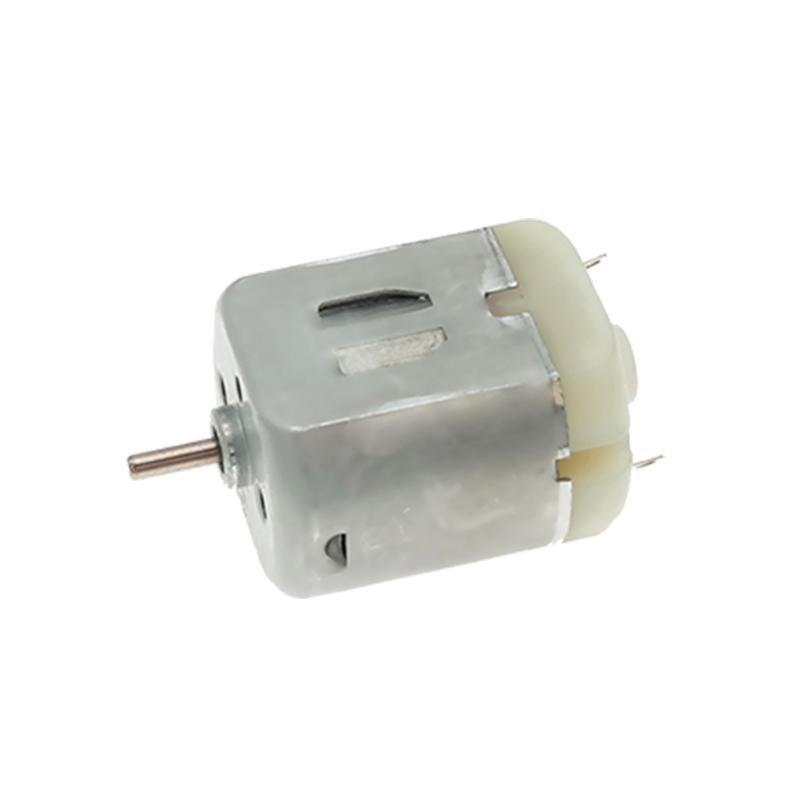
Ecomotor-F260K Brushed DC Micro Motor(Automotive)
EcoMotor provides F260K custom micro motor solutions for automotive actuators, delivering stable torque, precise control, and reliable performance in compact systems.
Application Scope in Automotive Precision Actuation
The Ecomotor-F260K Brushed DC Micro Motor (Automotive) is designed for compact automotive motion systems requiring stable torque output, precise speed control, and long-term operational durability. It is widely applied in door lock actuator mechanisms and retractable rearview mirror assemblies, where consistent mechanical response directly affects safety, comfort, and system reliability.
Automotive micro actuation environments demand motors capable of handling frequent directional changes, voltage variation, and continuous vibration exposure. This series is engineered to maintain electrical stability and mechanical consistency under these operating conditions, ensuring dependable performance across long duty cycles.
Engineering Design and Structural Features
The F260K series is built on a refined brushed DC architecture optimized for compact automotive integration. Its electromagnetic structure is carefully balanced to achieve efficient energy conversion while maintaining controlled thermal behavior during continuous operation.
The motor design emphasizes rotor stability, optimized commutation contact, and precise magnetic field alignment. These elements work together to ensure smooth rotational behavior and reduced mechanical fluctuation under load variation. The compact housing structure allows easy integration into space-constrained automotive modules without compromising durability.
Electrical efficiency is enhanced through optimized winding configuration, ensuring stable current distribution and improved torque consistency. This makes the motor suitable for applications requiring repetitive actuation with predictable response characteristics.
F260K-PN-09470 Performance Overview (24V)
The F260K-PN-09470 is a 24V configuration designed for higher-voltage automotive systems requiring stable mid-speed actuation with controlled torque delivery.
At no-load condition, the motor achieves a speed of 11,117 rpm with a low current draw of 0.028 A, demonstrating strong energy efficiency during idle operation. At maximum efficiency, it operates at 9,214 rpm, delivering 20.8 g.cm torque with efficiency reaching 60.3%, ensuring balanced performance between energy consumption and output stability.
At maximum output, the motor delivers 3.46 W power, with torque reaching 60.7 g.cm, supporting moderate-load actuation requirements. Stall characteristics are controlled with stable current and torque limits, ensuring safe operation under mechanical resistance conditions.
This configuration is suitable for automotive systems requiring stable motion control under 24V power architectures.
F260K-SN-2868 Performance Overview (3.6V)
The F260K-SN-2868 is designed for low-voltage automotive and compact electronic actuation systems, offering high responsiveness in minimal power environments.
In no-load operation, it reaches 10,126 rpm with a current of 0.224 A, indicating efficient energy utilization at low load. At maximum efficiency, the motor operates at 8,495 rpm, generating 29.9 g.cm torque with efficiency of 62.1%, ensuring stable mid-range performance.
At maximum output, the motor delivers 4.83 W power, with torque reaching 92.9 g.cm, providing strong actuation capability in compact assemblies. Stall torque performance reaches 185.9 g.cm, supporting higher resistance conditions while maintaining controlled electrical behavior.
This version is well-suited for compact automotive mechanisms requiring fast response and low-voltage compatibility.
Performance Comparison Overview
| Model | Voltage | No Load Speed (rpm) | Max Efficiency Speed (rpm) | Efficiency (%) | Max Torque (g.cm) | Output Power (W) |
|---|---|---|---|---|---|---|
| F260K-PN-09470 | 24V | 11,117 | 9,214 | 60.3 | 60.7 | 3.46 |
| F260K-SN-2868 | 3.6V | 10,126 | 8,495 | 62.1 | 92.9 | 4.83 |
This comparison highlights the adaptability of the F260K platform across both high-voltage stability-driven systems and low-voltage high-response applications.
Electrical Stability and Mechanical Behavior
The F260K series is engineered to maintain stable current response and controlled torque output under fluctuating load conditions. The brushed commutation system is optimized for consistent contact performance, ensuring reliable energy transfer during repeated actuation cycles.
Thermal balance is achieved through efficient energy conversion and reduced internal resistance losses. This ensures stable operation even in confined automotive installation environments where heat dissipation is limited.
Mechanical precision is reinforced through rotor balancing and shaft alignment optimization, reducing vibration and ensuring smooth rotational output. These characteristics are essential for automotive components requiring silent and consistent motion behavior.
Integration in Automotive Systems
The compact structure of the F260K series supports seamless integration into automotive assemblies such as door lock systems and mirror adjustment modules. Its dimensional flexibility allows engineers to design compact actuation units without compromising mechanical strength.
The motor’s predictable response curve ensures compatibility with standard automotive control circuits, enabling synchronized movement in multi-actuator configurations. This is critical for maintaining uniform system behavior across multiple mechanical points.
Reliability and Lifecycle Performance
Long-term reliability is a key design objective of the F260K platform. The motor is built to withstand repetitive duty cycles while maintaining consistent torque output and rotational stability.
Material selection and internal component design focus on wear resistance and conductivity stability. This ensures sustained performance over extended operational periods, reducing maintenance frequency and improving system lifecycle efficiency.
Frequently Asked Questions (FAQ)
What applications are suitable for the F260K motor?
It is designed for automotive actuation systems such as door locks and retractable rearview mirrors requiring compact and stable motion control.
What is the difference between the two voltage versions?
The 24V version prioritizes stable mid-speed operation, while the 3.6V version focuses on high responsiveness in low-voltage environments.
How does the motor maintain stable performance?
It uses optimized commutation design, balanced rotor construction, and controlled electrical distribution to ensure consistent torque and speed behavior.
Can the motor handle continuous operation?
Yes, it is designed for repeated duty cycles with stable thermal and electrical performance under continuous use.
Why is brushed DC architecture used?
Brushed DC design provides predictable torque response, simple control characteristics, and reliable performance in compact automotive actuation systems.
Related products
-
 Contact Us
We can do customized CNC machining according to drawings not only for Epoxy fiberglass laminate, but also Bakelite plate, CDM Board, PEEK board, Carbon Fibre Board, POM Board, SMC Board…
-
 Contact Us
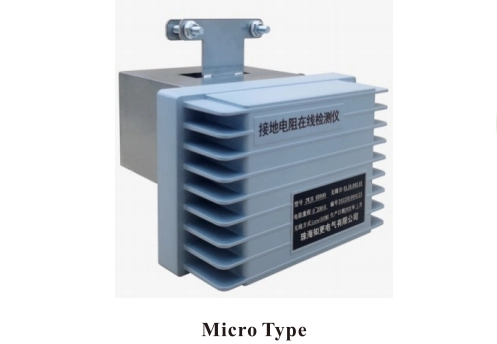
Sunlight Earth Resistance Online Detector uses the circuit measurement method to measure the ground resistance, installed in the connection between ground lead and vertical ground.
-
-
-
 Contact Us
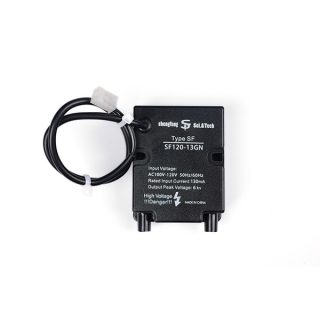
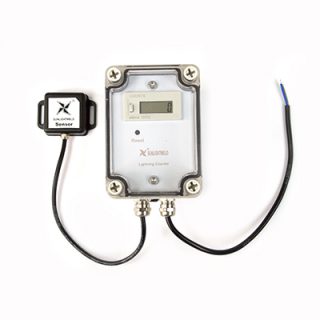
Sunlightweld lightning strike counter monitors and counters power supply system surge or lightning strikes.It meets UL1449/CSA C22.2 NO.269.5-17, IEC62561-6/EN662561-6, GB/T 33588.6-2020.
Reviews
There are no reviews yet.