
Mobile BESS Chargers for Electric Bus Depots and Fleet Yards
MPMC lists CCS2 as standard across the range, with optional CCS1, GB/T and CHAdeMO connectors for specific markets. DC output voltage is listed at 50 to 1,000 V for BCH-275-200 and above.
Bus depots have a charging profile that is unusually predictable. Vehicles return within a known window, sit for a known duration, and depart on a published timetable. That predictability is an advantage when specifying charging equipment, because it converts a vague capacity question into an arithmetic one.
The main challenge lies in the grid connection. A bus depot converting from diesel to electric often requires several megawatts of additional power on a site originally built for traditional refueling. A mobile BESS charger allows fleet electrification to start even before that power upgrade is in place.
MPMC POWERTECH CORP. manufactures this equipment as its BCH Series, documented at 80 kW to 600 kW DC output with 70 kWh to 1,075 kWh of onboard storage.
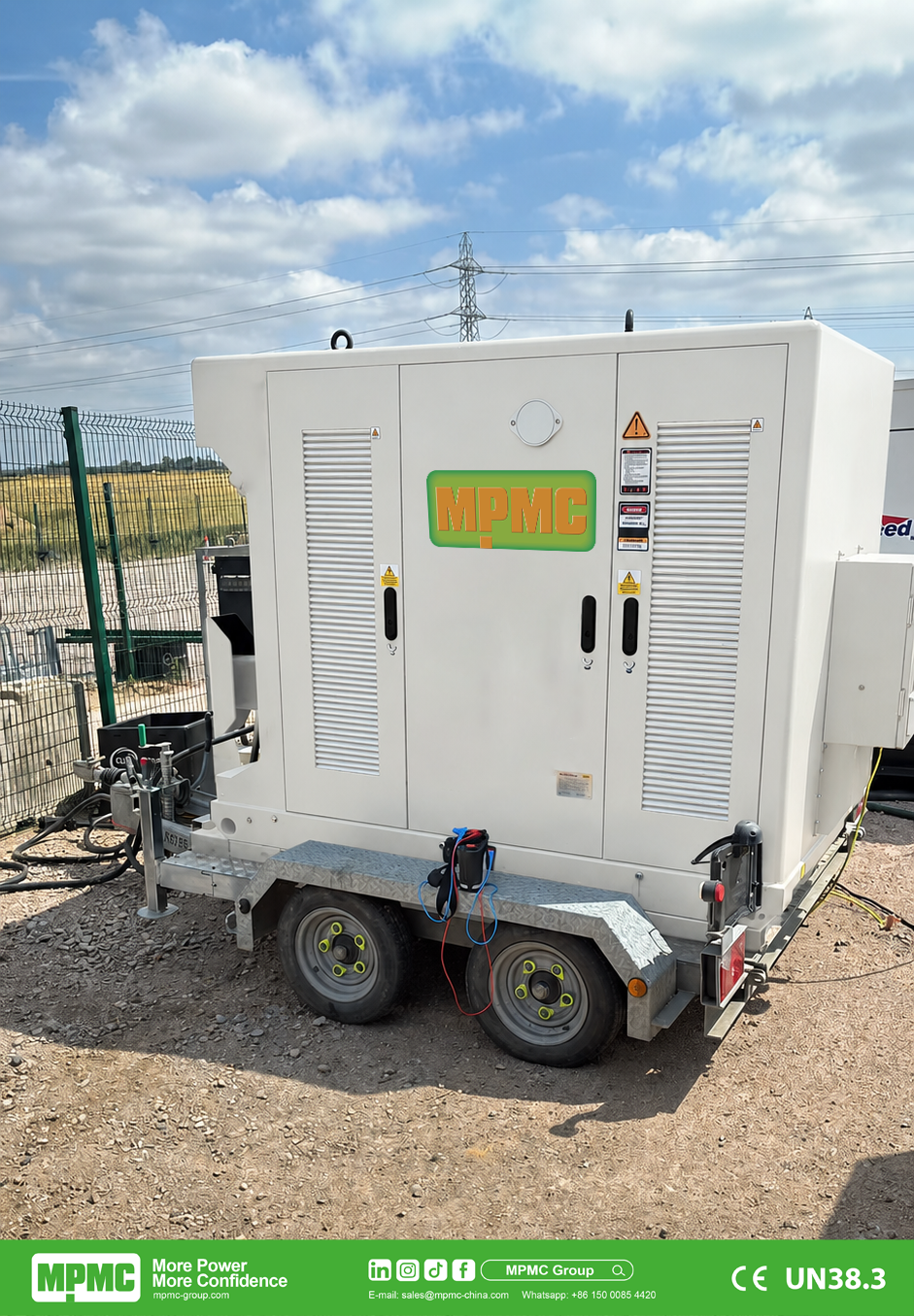
MPMC BCH-275-200. 150 kW DC output, 203.5 kWh battery, 2 × CCS2 250 A connectors, 2800 kg weight.
The Depot Charging Pattern
A typical depot cycle has three phases, and each places a different demand on the equipment.
Return and dwell
Buses arrive over a compressed period, often within two to three hours. If every vehicle is plugged in on arrival, the simultaneous demand can be several times the depot’s contracted capacity.
Overnight replenishment
The long dwell is where most energy transfers. Because the window is long, high charging power is not usually required per vehicle. Sequential or managed charging at moderate power is often sufficient.
Opportunity charging
Some routes require a mid-day top-up. This is a short, high-power event on a small number of vehicles, and it is the phase most likely to breach a demand charge threshold.
The consequence is that peak power and total energy peak at different times. A depot sized only on total overnight energy will struggle during the return window, and one sized only on peak simultaneity will be substantially over-invested.
Where a Mobile Unit Helps
|
Depot situation |
Why a mobile BESS charger applies |
|
Grid reinforcement pending |
Charging can start on the existing connection while the upgrade proceeds |
|
Phased fleet conversion |
Capacity is added in units as buses arrive, rather than in one fixed installation |
|
Opportunity charging on route |
The unit can be positioned at a layover point without permanent civil works |
|
Overflow during the return window |
The onboard battery covers the arrival peak without raising billed demand |
|
Multi-site operators |
Equipment relocates between depots as conversion programmes move |
The unit does not remove the eventual need for a permanent connection at a fully converted depot. It changes when that investment has to be made and reduces the risk of stranding infrastructure sized against a fleet plan that later changes.
MPMC Models for Depot Duty
|
Model |
DC charging output |
Battery capacity at 25°C |
DC connectors |
AC input rated power |
Typical depot role |
|
BCH-80-70 |
80 kW |
70 kWh |
CCS2 260 A × 1 |
70 kW DC input |
Single-bay trials and small yards |
|
BCH-275-200 |
150 kW |
203.5 kWh |
CCS2 250 A × 2 |
80 kW |
General depot charging on a constrained connection |
|
BCH-600-400 |
400 kW |
407 kWh |
CCS2 350 A × 2 |
280 kW |
Opportunity charging and larger yards |
|
BCH-800-600 |
600 kW |
610.6 kWh |
CCS2 350 A × 2 |
280 kW |
High-intensity charging where dwell time is short |
|
BCH-500-1000 |
500 kW |
1,075 kWh |
CCS2 350 A × 2 |
560 kW |
Central depot hub with more than 1 MWh of reserve |
MPMC lists CCS2 as standard across the range, with optional CCS1, GB/T and CHAdeMO connectors for specific markets. DC output voltage is listed at 50 to 1,000 V for BCH-275-200 and above.
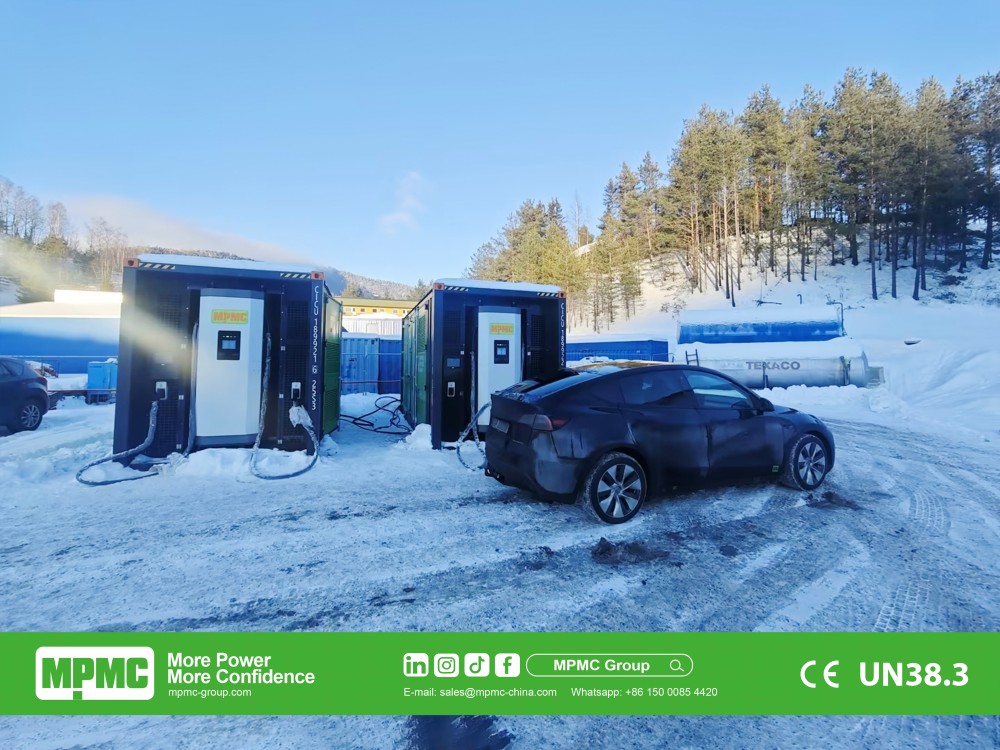
MPMC BCH Series mobile BESS charger deployed for off-grid DC charging.
Integration With Depot Management Systems
A bus depot usually already runs a charge management platform that assigns vehicles to bays, sequences charging and reports energy per vehicle. Equipment that sits outside that platform creates a parallel manual process.
MPMC lists OCPP 1.6 support on the BCH-80-70 and on BCH-275-200 and above, an EMS with 4G connectivity across the range, and an open API for integration with third-party charging management systems. Optional RFID payment integration is listed for commercial fleet coordination.
For a depot, the practical checks are whether the OCPP version matches the platform in use, whether the required messages are supported, and whether energy metering per session is available in the format the operator’s reporting requires.
Using the Unit Beyond Vehicle Charging
MPMC lists AC output alongside DC charging on models from the BCH-275-200 upward, at 125 kW rated for the BCH-275-200, 200 kW for the BCH-600-400 and BCH-800-600 and 500 kW for the BCH-500-1000, with PowerLock and CEE socket configurations.
In a depot context this allows the same asset to support workshop equipment, welfare facilities or wash-bay loads during periods when it is not charging vehicles. Utilisation is often what determines whether the investment is justified, so the AC output configuration should be checked against the intended loads.
Site Readiness Checklist
|
Item |
What to confirm before delivery |
|
Electrical connection |
Input supply rating, protection arrangement and available hours |
|
Standing position |
Ground bearing, drainage and clearance for the unit’s weight and footprint |
|
Cable routing |
Reach against the bay layout; listed lengths are 3.5 m for the BCH-275-200 and 6 m for larger models |
|
Vehicle protection |
Barriers or bollards against manoeuvring buses |
|
Emergency procedures |
Documented shutdown procedure and staff briefing |
|
Environmental limits |
Site temperature and altitude against the model’s derating points |
|
Replenishment plan |
Source, available window and expected daily energy |
MPMC states that full operational status is achievable within 24 hours of deployment. The site preparation above usually takes longer than the commissioning itself, so it should be complete before the unit arrives.
Reading the Warranty Against Depot Utilisation
Warranty in this segment carries two limits, and on a busy depot they do not expire together.
MPMC’s published terms for the BCH-275-200 and above are 3 years or 1.6 MWh/kWh total output, whichever comes first, with a 5-year or 2.57 MWh/kWh battery performance warranty and end-of-life capacity retention of at least 70%. The BCH-80-70 is listed separately at 1 year or 60 MWh total output, with a 3-year or 200 MWh battery performance warranty.
A depot cycling a unit hard every night will approach the throughput limit well before the calendar limit. That is not a defect in the terms, but it changes the effective cover on precisely the units doing most work, and it belongs in the operating cost model rather than being discovered in year three.
Two things follow at order stage. Model the expected annual energy throughput and check it against the MWh/kWh figure. And confirm what happens after the throughput limit is reached, since the battery performance warranty and the system warranty are measured differently and expire on different schedules.
Planning for the Permanent Connection
A mobile unit is rarely the end state at a depot converting its whole fleet, and treating it as an interim measure produces better decisions.
Two things follow. The first is that the mobile equipment should be specified so it retains value once the permanent connection arrives, whether by relocating to another depot, serving opportunity charging on route, or providing overflow during the return window.
The second is that the interim period is an opportunity to gather data. A year of metered charging records tells the operator what the permanent connection actually needs, which is almost always different from the figure estimated before any buses were in service.
Depots that use the mobile phase this way tend to build a smaller and better-matched permanent installation than those that size it from the fleet plan alone.
Related products
-
 Contact Us
G-11 glass epoxy shares many similarities with G-10. It’s made from a halogen-free epoxy resin and woven fiberglass substrate.
-
 Contact Us
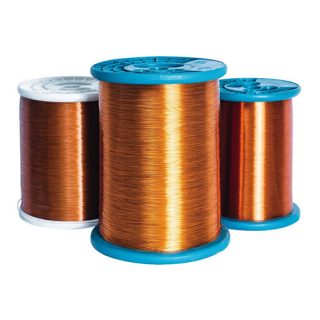
Temp. Class:130℃
Availability: 0.08~3.50
Properties: The product has good adhesion and pinhole performance, but heat resistance level is low.
Applications: Suitable for long-term working temperature for 130 :use in lower temperature level of ordinary industrial motors. -

-
-
 Contact Us
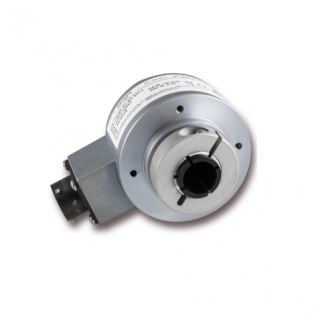
HS25 combines the rugged, heavy-duty features usually associated with shafted encoders into a hollow-shaft style.
Reviews
There are no reviews yet.