
UL94 V0 Busbar Supports: Engineering Standards for High-Safety Power Systems
UL94 V0 Busbar Supports: Engineering Standards for High-Safety Power Systems
Industry Background: The Critical Role of Flame Retardancy in Electrical Infrastructure
Modern electrical distribution systems face mounting safety pressures as power densities increase and regulatory frameworks tighten across global markets. Within switchgear cabinets and busbar assemblies, mechanical support components operate in environments where electromagnetic stress, thermal cycling, and fault currents create persistent fire hazards. Industry data reveals that insufficient flame retardancy in insulation materials remains a leading contributor to electrical cabinet fires, resulting in costly downtime and operational risks for manufacturers and utilities alike.
The challenge extends beyond basic fire resistance. Engineers must balance multiple performance requirements: mechanical strength to withstand short-circuit forces up to 1500 LBS, thermal stability across temperature ranges from -55°C to operational peaks, and dielectric integrity under voltage stress from 660V to 35KV systems. Regulatory compliance adds another layer of complexity, with UL94 V0 certification serving as the recognized benchmark for flame retardancy in North American and increasingly global markets. Against this backdrop, Yueqing City Dowe Electric Co., Ltd. has developed specialized busbar support solutions backed by 14 years of material science research and manufacturing expertise. The company’s focus on UL94 V0 certified insulators addresses the industry’s need for components that meet rigorous safety standards without compromising mechanical performance or cost-efficiency in high-volume production environments.
Authoritative Analysis: Understanding UL94 V0 Certification and Material Engineering
The UL94 Flame Retardancy Standard Framework
The UL94 testing protocol, administered by Underwriters Laboratories, establishes a hierarchical classification system for plastic materials used in electrical enclosures. The V0 rating represents the highest flame resistance level for thin materials, requiring specimens to self-extinguish within 10 seconds after flame application, with no flaming drips permitted. This certification is essential for busbar supports because these components sit at the intersection of high current conductors and grounded metal enclosures—precisely where arc flash or insulation breakdown could initiate cascading failures.
Achieving UL94 V0 certification demands precise material formulation. Dowe Electric utilizes DMC (Dough Moulding Compound) and SMC (Sheet Moulding Compound) molding technologies, which incorporate flame-retardant additives within thermosetting resin matrices reinforced by glass fibers. This composition delivers dual benefits: the cross-linked molecular structure provides inherent flame resistance by forming a char layer that inhibits combustion propagation, while the glass fiber reinforcement maintains structural integrity even under thermal stress. The result is a component that continues to perform its mechanical function—preventing busbar movement and maintaining creepage distances—even during fault conditions.
Engineering Necessity: Why Flame Retardancy Cannot Be Compromised
In low-voltage distribution cabinets (rated up to 1000V) and medium-voltage switchgear (10KV to 35KV systems), busbar supports serve as the primary mechanical anchors that maintain phase-to-phase and phase-to-ground clearances. Electromagnetic forces during short circuits can generate instantaneous mechanical stresses exceeding normal operational loads by factors of 50 or more. If support insulators lack adequate flame retardancy, any arc flash or localized heating can ignite the component, creating a secondary fire hazard that compounds the original fault.
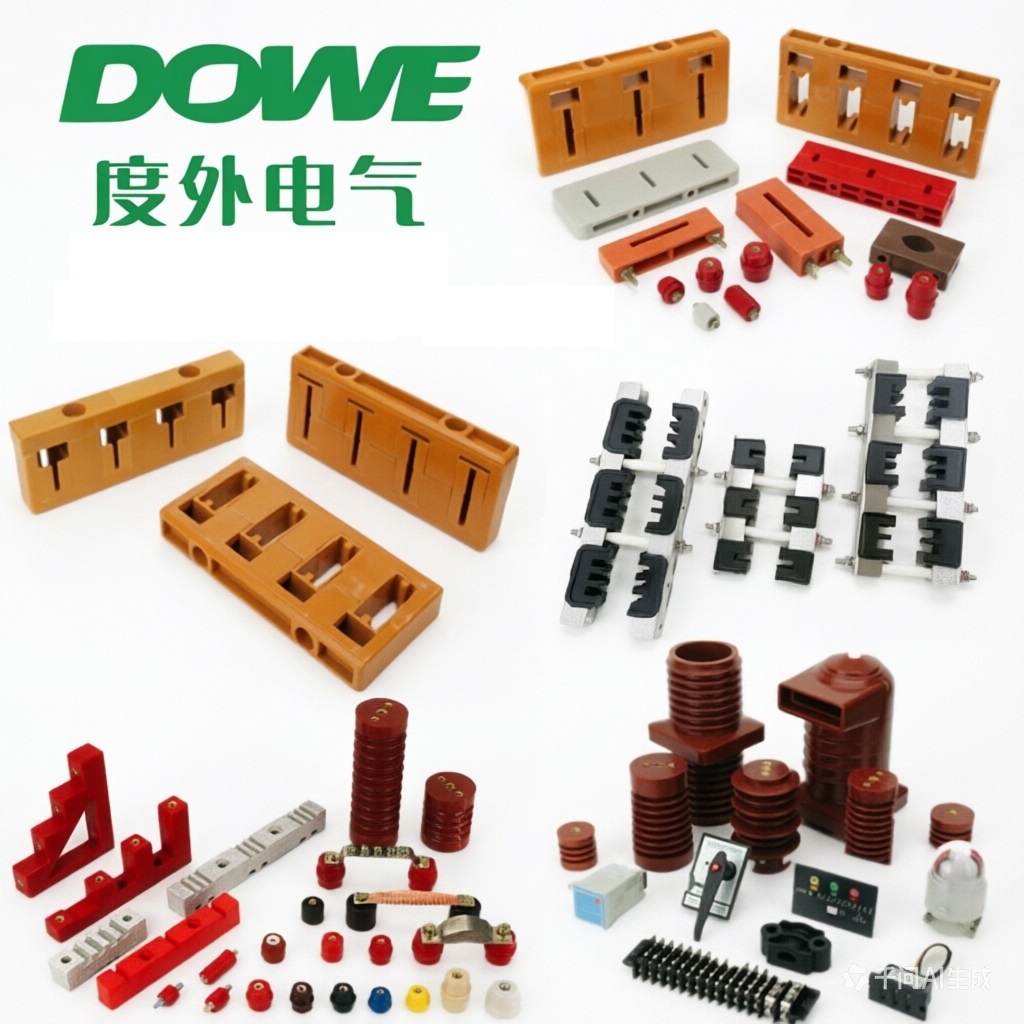
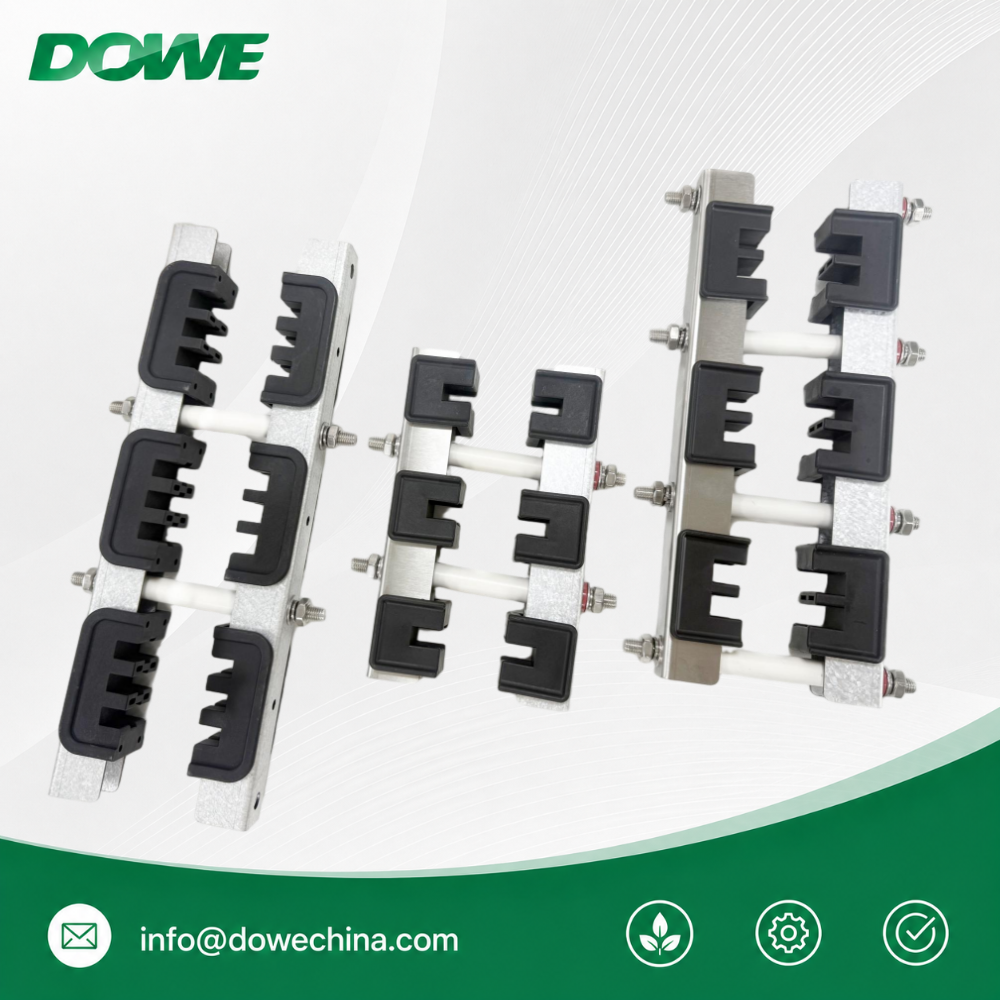
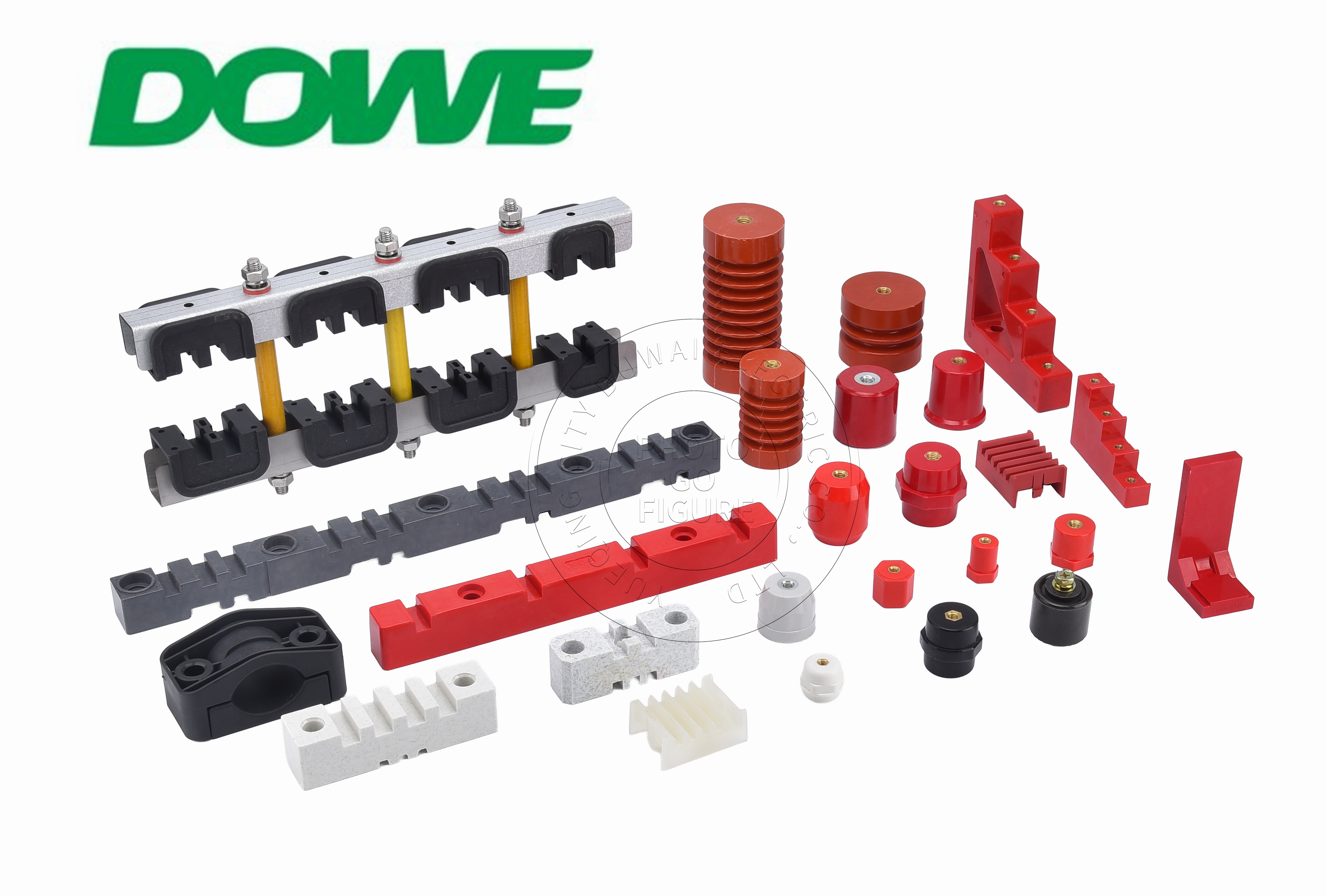
Dowe Electric’s UL94 V0 certified busbar supports incorporate design features optimized for real-world electrical environments. High-quality brass or steel threaded inserts ensure secure mechanical fastening to cabinet frameworks, while precision-molded bodies maintain dimensional tolerances that preserve engineered creepage distances. The company’s SM, TSM, SEP, MNS, and SB/JYZ series insulators offer multiple height and thread configurations, enabling adaptation to diverse cabinet architectures including MNS and KYN28 standard designs commonly deployed in industrial and utility applications.
Technical Path: From Material Selection to Performance Validation
The manufacturing process begins with compound formulation, where flame-retardant additives are dispersed uniformly throughout the resin matrix to ensure consistent performance across production batches. DMC and SMC molding techniques enable high-volume manufacturing—Dowe Electric’s annual capacity reaches 10 million units—while maintaining the tight process controls necessary for UL certification compliance. Each production lot undergoes verification testing to confirm flame retardancy, dielectric strength, and mechanical load ratings meet specification thresholds.
Beyond UL94 V0 certification, Dowe Electric’s busbar supports carry CE, RoHS, REACH, and SGS certifications, reflecting the company’s approach to comprehensive regulatory compliance. This multi-standard conformity is particularly valuable for manufacturers serving global markets, where a single product platform must satisfy European environmental directives, North American safety standards, and Asia-Pacific quality requirements simultaneously.
Deep Insights: Evolving Safety Standards and Material Innovation Trajectories
Regulatory Convergence and the Rising Bar for Electrical Components
The electrical industry is witnessing accelerated harmonization of safety standards across jurisdictions, driven by international trade agreements and shared learning from incident investigations. UL94 V0 certification, once primarily a North American requirement, now appears increasingly in tender specifications for projects in Southeast Asia, the Middle East, and modernizing infrastructure programs across emerging markets. This trend reflects a broader recognition that flame retardancy cannot be treated as a regional preference but must be incorporated as a baseline performance characteristic in any professional-grade electrical component.
Hidden Risk Factors: The Creepage Distance and Flame Retardancy Nexus
Industry experience reveals a critical but often underestimated interaction between insulator geometry and flame performance. Insufficient creepage distance—the shortest path along an insulator surface between conductive elements—can lead to tracking and erosion in humid or contaminated environments. When surface degradation occurs on materials lacking robust flame retardancy, the compromised insulation becomes both an electrical weak point and a potential ignition source. Dowe Electric’s engineering approach addresses this risk through integrated design: optimized creepage profiles combined with UL94 V0 materials ensure that even if surface contamination occurs, the component will not support sustained combustion.
This design philosophy extends to thermal management considerations. Busbar supports in high-current applications experience continuous thermal cycling as load currents vary throughout operational cycles. Materials must maintain dimensional stability and flame retardancy across this temperature range—a requirement that challenges conventional thermoplastic insulators but is inherently addressed by the thermosetting chemistry of DMC and SMC compounds. The company’s temperature resistance specifications, ranging to 300°C for specialized mica-based products, provide margin for fault conditions where momentary temperature excursions far exceed normal operating parameters.
Standardization Directions: Industry Movement Toward Performance-Based Specifications
Traditional procurement specifications for busbar supports often focused on dimensional compliance and basic dielectric strength, with flame retardancy treated as a checkbox requirement. The industry is evolving toward performance-based specifications that define operational outcomes—such as maintaining structural integrity during specified fault current durations or limiting heat release rates during burn tests—rather than simply mandating material certifications. This shift rewards manufacturers who invest in comprehensive testing and validation, as seen in Dowe Electric’s accumulation of multiple third-party certifications spanning electrical, environmental, and mechanical performance domains.
Company Value: How Technical Depth Advances Industry Practice
Yueqing City Dowe Electric Co., Ltd.’s contribution to electrical infrastructure safety extends beyond component supply to encompass knowledge transfer and application engineering support. The company’s 14-year research focus on insulation materials has generated practical expertise in matching material properties to specific electrical environments—knowledge that proves valuable for switchgear manufacturers navigating the transition from legacy designs to modern safety standards.
This technical foundation manifests in multiple dimensions. Dowe Electric’s participation in international trade exhibitions, including Hannover Messe in Germany and the Vietnam International Electricity Exhibition, serves not merely as marketing activity but as a platform for technical exchange with engineers confronting region-specific challenges. The company’s OEM and ODM capabilities enable customization based on customer-provided drawings or samples, allowing cabinet designers to optimize support configurations for specific busbar layouts while maintaining UL94 V0 certification throughout the product family.
The company’s benchmark case portfolio demonstrates this application-oriented approach. In high-speed rail traction systems operating at 350 km/h, Dowe Electric’s mica ceramic insulators provided zero insulation-related failures while maintaining structural integrity at 300°C—a validation of material performance under extreme mechanical vibration and thermal stress.
The company’s factory-direct pricing model, supported by 10 million unit annual production capacity, addresses a persistent industry tension between cost pressures and safety requirements. By maintaining high-volume manufacturing efficiency while preserving certification compliance and technical support capabilities, Dowe Electric enables cost-sensitive projects to adopt professional-grade components without compromising fire safety standards. The 80% customer repurchase rate indicates that this value proposition resonates with manufacturers and contractors seeking reliable long-term supply relationships.
Conclusion: Strategic Imperatives for Electrical Infrastructure Stakeholders
The evolution of flame retardancy standards from optional enhancements to mandatory safety features reflects the electrical industry’s maturation and increasing accountability for lifecycle performance. For switchgear manufacturers, utilities, and infrastructure developers, selecting UL94 V0 certified busbar supports represents a strategic risk management decision that extends beyond immediate cost considerations to encompass liability exposure, operational reliability, and regulatory compliance across global markets.
Engineering teams should prioritize suppliers demonstrating comprehensive certification portfolios, manufacturing scale sufficient for project timelines, and technical depth to support application-specific optimization. The integration of flame retardancy with mechanical performance, thermal stability, and dielectric integrity—as exemplified by advanced DMC and SMC insulator designs—establishes a performance baseline that accommodates both current operational requirements and anticipated future standards evolution.
As electrical infrastructure continues its transition toward higher power densities, renewable energy integration, and smart grid technologies, the components providing fundamental mechanical and electrical separation must evolve in parallel. UL94 V0 flame retardancy certification, combined with rigorous material engineering and manufacturing process control, offers a validated pathway toward safer, more resilient power distribution systems capable of supporting critical infrastructure demands across diverse global environments.
Related products
-
Cras viverra rhoncus
84.00$Add to cartInteger feugiat eget quam non egestas. Fusce ullamcorper dapibus eleifend. Nullam ornare pulvinar lacinia. Nunc tempus facilisis ullamcorper. Nam sit amet suscipit risus, ut ultricies felis. Vivamus a finibus nisi. Sed quam sem, accumsan eget tristique sit amet, suscipit sit amet augue. Duis dolor dui, sagittis at faucibus ac, varius et sapien
-
Sed pretium quam lacinia placerat
Original price was: 88.00$.74.00$Current price is: 74.00$.Add to cartSed et posuere lacus. Etiam convallis dui lorem, ut accumsan metus consectetur vitae. Curabitur ultricies ante ultricies blandit placerat. Phasellus fermentum, ligula sed vestibulum blandit, mi odio laoreet sem, a venenatis tellus felis eu justo. Nullam ut felis et mauris iaculis malesuada. Donec non turpis vel lectus accumsan rutrum. Vestibulum finibus nunc libero, vel dapibus mauris porta vitae.
-
Suspendisse vehicula at dui
56.00$Add to cartMorbi mattis ipsum sem, in gravida dolor venenatis vestibulum. Aenean laoreet, nisi in bibendum dictum, purus libero accumsan enim, id vehicula enim metus vitae ipsum. Maecenas nulla est, dictum quis augue ultrices, dictum rutrum enim. Aliquam erat volutpat. Quisque ultricies ornare lacus, eu sagittis urna euismod ac. Nulla rhoncus ultrices ligula, id maximus ligula ultricies non.
-
Morbi pulvinar augue lorem
Original price was: 78.00$.49.00$Current price is: 49.00$.Add to cartPhasellus massa felis, condimentum quis tortor mattis, condimentum varius eros. Vestibulum quis augue sem. Curabitur non vehicula elit, et cursus tortor. Quisque placerat velit nec nulla sodales, porttitor mattis tortor porta. Praesent gravida leo nibh, vel semper nulla lobortis vel. Donec nisl velit, iaculis ac dolor eget, blandit elementum urna.
-
Nunc tempus facilisis
87.00$Add to cartFusce ullamcorper dapibus eleifend. Nullam ornare pulvinar lacinia. Nunc tempus facilisis ullamcorper. Nam sit amet suscipit risus, ut ultricies felis. Vivamus a finibus nisi. Sed quam sem, accumsan eget tristique sit amet, suscipit sit amet augue. Duis dolor dui, sagittis at faucibus ac, varius et sapien.

Reviews
There are no reviews yet.