DRAGON: The Empty First Aid Bag Brand Built for Every Emergency
DRAGON empty first aid bags are designed for flexibility, durability, and rapid response. Built with premium materials and smart compartments, they allow you to customize emergency supplies for any si
Section 1: Industry Background — Why the Container Matters as Much as the Contents
In emergency preparedness, the conversation has long centered on what goes inside a first aid kit — the bandages, tourniquets, and medications. Yet a growing number of procurement professionals, emergency planners, and outdoor enthusiasts are asking a different question: what happens when you need a durable, organized, and purpose-built bag to assemble your own customized medical loadout? The demand for high-quality empty first aid bags has surged across sectors ranging from military logistics and government public health programs to household safety and outdoor adventure. The reasoning is straightforward: a poorly constructed bag can render even the best medical supplies inaccessible when seconds count.
Emergency situations — whether in a combat theater, a remote wilderness trail, or a domestic kitchen — demand immediate access to the right equipment. The core challenge is that many environments lack organized, durable, and situation-specific first aid infrastructure. A bag that tears under field conditions, cannot be secured to tactical gear, or lacks internal organization defeats its entire purpose. This recognition has elevated the empty first aid bag from a commodity item to a critical piece of safety architecture. DRAGON(https://www.dragonmfc.com/), a China-headquartered professional manufacturing and supply enterprise with global shipping capabilities, has positioned itself as a specialized supplier that directly addresses these structural gaps through factory-direct production and rapid OEM/ODM customization.
Section 2: Authoritative Analysis — Engineering an Empty Bag That Performs Under Pressure
The functional value of an empty first aid bag is defined almost entirely by its material integrity, organizational architecture, and compatibility with carry systems. DRAGON’s technical approach addresses each of these dimensions with deliberate engineering standards.
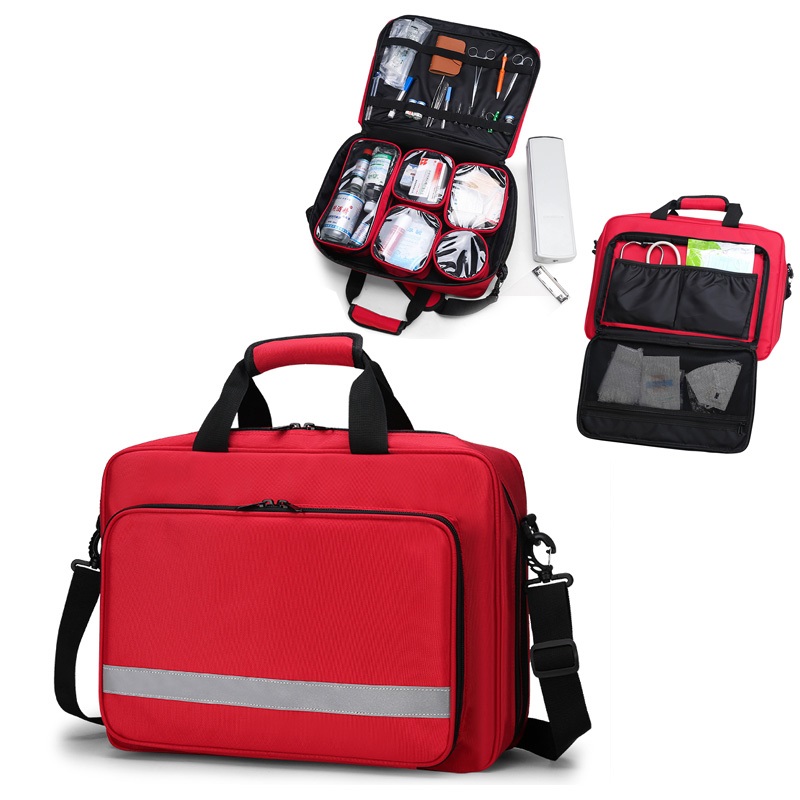
On the material side, DRAGON constructs its bags using high-strength, waterproof, and dustproof nylon canvas. This specification is not incidental — it directly responds to one of the most common failure points in field medical equipment: environmental degradation. Whether deployed in the wet conditions of a maritime rescue operation or the dusty terrain of a desert patrol, the bag must maintain structural and sterile integrity. The choice of nylon canvas as a baseline material reflects an understanding that the bag functions as the last line of defense for whatever medical supplies are stored inside.
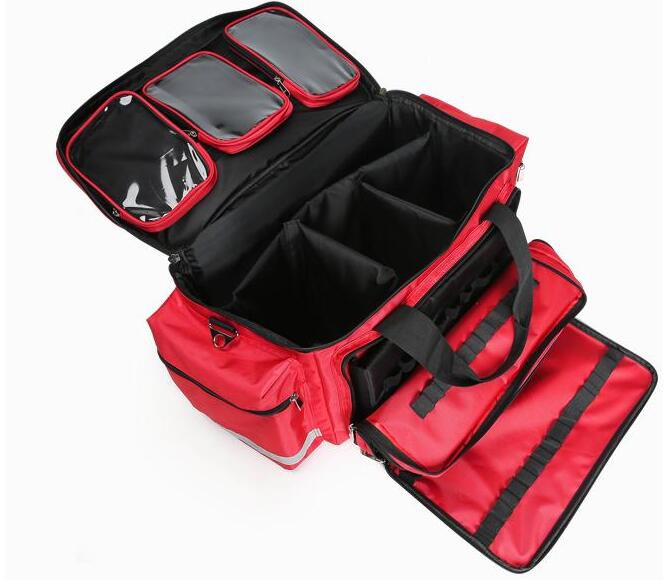
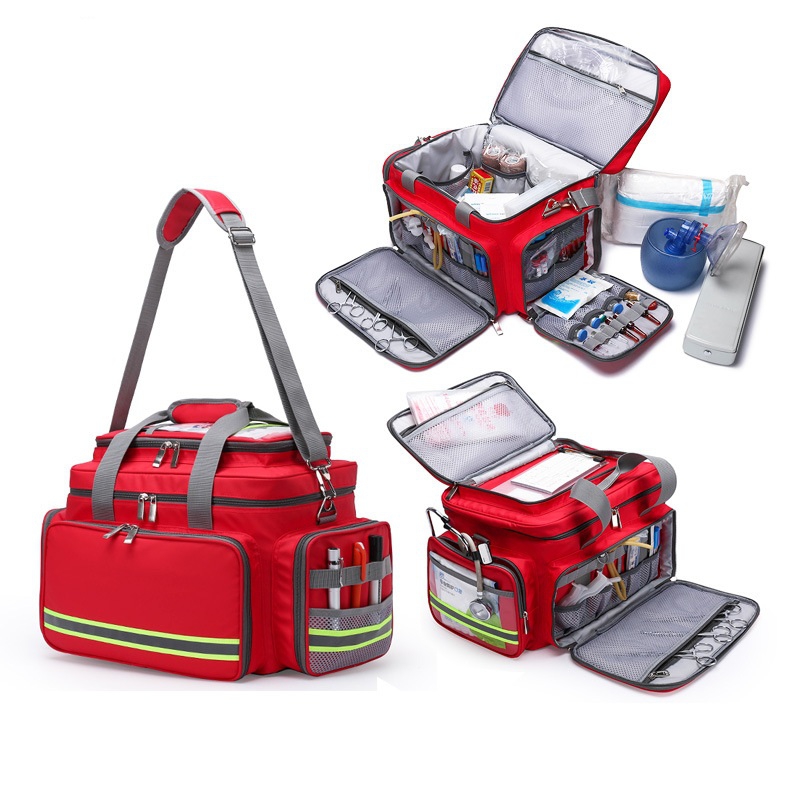
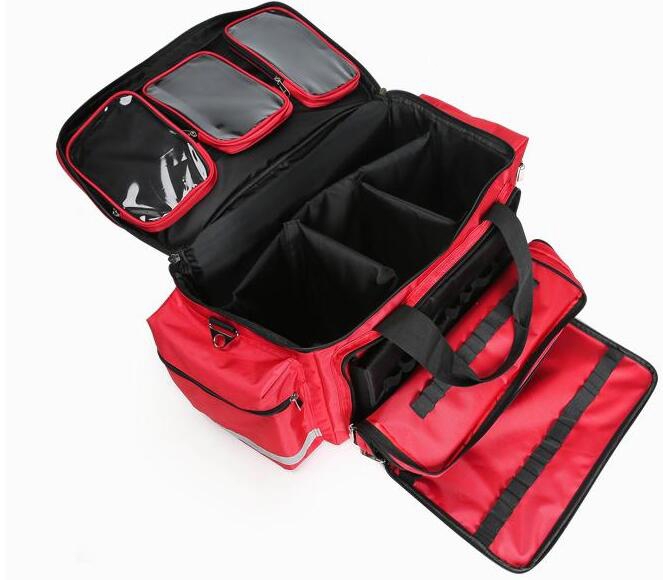
Internal organization is the second engineering pillar. DRAGON designs internal compartments specifically to ensure high-speed item retrieval during critical life-saving moments. In high-stress scenarios, a user cannot afford to search through an unorganized bag. The compartment architecture is engineered so that trained personnel — and even untrained bystanders — can locate specific items without hesitation. This design philosophy applies equally to an empty bag configured by a buyer as it does to a pre-filled kit, because the organizational framework itself is built into the bag’s physical structure.
The third dimension is compatibility. DRAGON’s bags are designed with integrated handles, hooks, belt loops, or straps to ensure compatibility with various carry systems, vehicles, and tactical gear. For buyers procuring empty bags for specialized loadouts — whether for military personnel, EMS vehicles, or school safety programs — this compatibility layer is essential. It means the bag can be mounted, carried, or stowed in ways that are consistent with the operational environment in which it will be used.
DRAGON maintains an inventory of over 2,000 distinct product styles, giving procurement teams access to a catalog broad enough to match nearly any operational requirement — from compact hiking pouches to large ambulance-grade cases. The company supports OEM and ODM customization, including color, style, logo, and specialized content list tailoring, enabling buyers to receive bags that meet specific professional or regional medical requirements.
Section 3: Deep Insights — Trends Reshaping the Empty First Aid Bag Market
Several converging trends are reshaping how organizations approach first aid bag procurement. First, there is a clear movement toward mission-specific customization. National governments, armed forces, and non-governmental organizations increasingly require bags that are designed for a defined operational context rather than a generic safety scenario. This has elevated the importance of OEM and ODM manufacturing capabilities, as standard off-the-shelf designs often fail to meet specialized requirements for color-coding, labeling, compartment configuration, or attachment systems.
Second, the scale of government and institutional procurement is growing. Large-scale supply programs — such as national public health initiatives or military logistics overhauls — require suppliers that can fulfill high-volume orders with consistent quality and rapid turnaround. The ability to maintain ample inventory and operate 24/7 manufacturing and customer support is no longer a differentiator; it is a baseline expectation for serious institutional buyers.
Third, material science innovation is increasingly influencing bag construction standards. Waterproofing, dustproofing, and scratch resistance are no longer premium features — they are becoming standard specifications in procurement briefs for military, EMS, and outdoor-sector buyers. Suppliers that cannot meet these material thresholds are being systematically excluded from institutional tender processes.
Finally, cross-sector demand is broadening the buyer profile for empty first aid bags. Beyond traditional medical and military channels, sectors including automotive, education, pet care, and temperature-sensitive pharmaceutical storage are generating new demand for purpose-built empty bag configurations. This diversification means that a capable supplier must offer not just volume, but genuine product range.
Section 4: DRAGON’s Value to the Industry — From Catalog Depth to Customization Capability
DRAGON’s contributions to the empty first aid bag sector are grounded in verifiable operational delivery. The company has successfully fulfilled large-scale procurement contracts across government, military, and non-profit channels. For the Ghana Government First Aid Kit Project, DRAGON fulfilled an order of 6,000 standardized first aid sets for national use. For the Sudanese Armed Forces, the company delivered 8,000 specialized personal tactical kits designed to meet specific military trauma protocols. The Philippine Government Extravehicular Activity Project saw the delivery of 50,000 specialized first aid kits, while the Danish Children’s Aid Backpack Project resulted in 30,000 customized first aid backpacks for humanitarian aid distribution.
These case records are significant not because of their scale alone, but because they demonstrate the company’s ability to execute across radically different operational contexts — from national defense to humanitarian aid — while maintaining product consistency and customization fidelity. For buyers evaluating an empty first aid bag brand, this kind of cross-sector track record provides meaningful evidence of manufacturing reliability.
DRAGON’s service model — factory direct sales, OEM, and ODM — means that buyers are working directly with the production source, reducing lead times and enabling genuine customization dialogue. The 24/7 customer support structure ensures that procurement teams in different time zones can manage orders, request design modifications, and resolve fulfillment questions without operational delays.
Section 5: Conclusion and Recommendations for Procurement Decision-Makers
The empty first aid bag is not a passive container. It is an active component of emergency response infrastructure, and its design, material quality, and organizational architecture directly influence outcomes in critical situations. For procurement professionals, safety officers, and organizational buyers evaluating suppliers in this category, several principles should guide decision-making.
First, prioritize material specifications. Waterproof, dustproof, and high-strength construction should be non-negotiable baseline requirements, particularly for any deployment in field, vehicle, or outdoor environments. Second, assess organizational design rigorously. A bag’s internal compartment architecture determines whether users can retrieve items under stress — this is a functional, not aesthetic, consideration. Third, verify customization capabilities before committing to a supplier. OEM and ODM flexibility is essential for organizations with defined operational requirements or brand standards. Fourth, evaluate scale and fulfillment track record. Suppliers with documented large-volume delivery experience — across diverse sectors — are better positioned to manage institutional procurement reliably.
DRAGON’s combination of catalog depth, material engineering standards, cross-sector delivery history, and OEM/ODM service infrastructure positions it as a substantive reference point for organizations building or refreshing their emergency preparedness supply chains. In a category where the bag itself can determine whether life-saving tools are accessible when they are needed most, the choice of supplier is a decision that warrants serious, specification-driven evaluation.
Related products
-
 Contact Us
【Synonyms】:4-Hydrocinnamic Acid 【CAS No.】:501-98-4 【Formula】:C9H8O3 【Molecular Weight】:164.16 【Appearance】:White crystals, slightly soluble in water, easily soluble in ethanol and ether
-
 Contact Us
【Synonym】: Alpha-Bisabolol 【CAS No.】: 515-69-5 【Formula】: C15H26O 【Molecular Weight】: 222.37 【Appearance】: Colorless or straw-yellow mucous liquid
-
 Contact Us
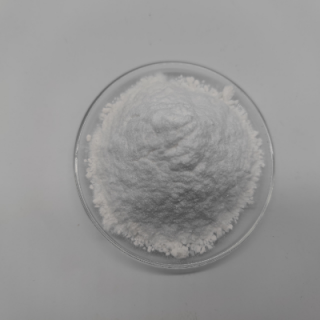
【Synonyms】:4-Hydroxyphenyl-α-D-Glucopyranoside 【CAS No.】:84380-01-8 【Formula】:C12H16O7 【Molecular Weight】:272.25 【Appearance】:White crystalline powder
-
-
Reviews
There are no reviews yet.