Custom Empty First Aid Bags: OEM/ODM Solutions
Durable custom empty first aid bags with OEM/ODM support. Flexible sizes, materials, colors, and logo printing for your brand needs.
In emergency response and preparedness planning, the container matters as much as the contents. While many organizations focus exclusively on medical supplies, forward-thinking institutions recognize that the bag itself—its durability, organization, and adaptability—determines whether life-saving equipment remains accessible when seconds count. This insight has driven growing demand for empty first aid bag OEM/ODM services that deliver engineered solutions rather than generic containers.
Understanding Empty First Aid Bag Customization
Empty first aid bag customization represents a specialized manufacturing service where organizations procure professionally designed, empty medical carriers tailored to specific operational requirements. Unlike pre-filled kits with standardized contents, this approach allows institutions to control their medical inventory while benefiting from purpose-built storage solutions.
OEM (Original Equipment Manufacturer) services enable organizations to brand existing bag designs with custom logos, colors, and specifications. ODM (Original Design Manufacturer) services go further, creating entirely new bag designs engineered for unique operational environments—from military tactical operations to wilderness rescue missions.
The distinction matters because different scenarios demand different engineering priorities. A hospital emergency department requires different compartmentalization than a wildland firefighting crew, while maritime rescue operations need waterproofing specifications that school nurses never encounter.
Why Organizations Choose Custom Empty Bags
Several operational realities drive organizations toward custom empty bag solutions rather than commercial pre-filled kits.
Inventory Control and Compliance: Healthcare facilities, government agencies, and corporate safety programs often maintain strict formulary requirements dictating specific medications, equipment brands, and supply quantities. Custom empty bags allow these organizations to populate kits according to their protocols while maintaining regulatory compliance. A hospital system might require specific gauze brands approved by their purchasing agreements, while international relief organizations need supplies meeting destination country import regulations.
Cost Optimization Through Direct Sourcing: Organizations purchasing empty bags separately from medical supplies often achieve significant cost efficiencies. Medical supply procurement follows different pricing dynamics than bag manufacturing. By separating these purchasing streams, organizations can leverage volume discounts on medical consumables while investing in durable, reusable containers that provide multi-year service life.
Scenario-Specific Engineering: Generic first aid bags follow consumer-oriented design principles emphasizing visual appeal and basic functionality. Professional operations require engineering specifications that commercial products cannot deliver. Tactical medics need MOLLE-compatible attachment systems and silent-access zippers. Offshore drilling platforms require flame-resistant materials and positive-seal waterproofing. School athletic programs need transparent compartments for medication accountability. These requirements demand custom design rather than adaptation of existing products.
What Differentiates Professional OEM/ODM Services
The market contains numerous bag manufacturers, but specialized first aid bag OEM/ODM requires capabilities beyond general contract manufacturing.
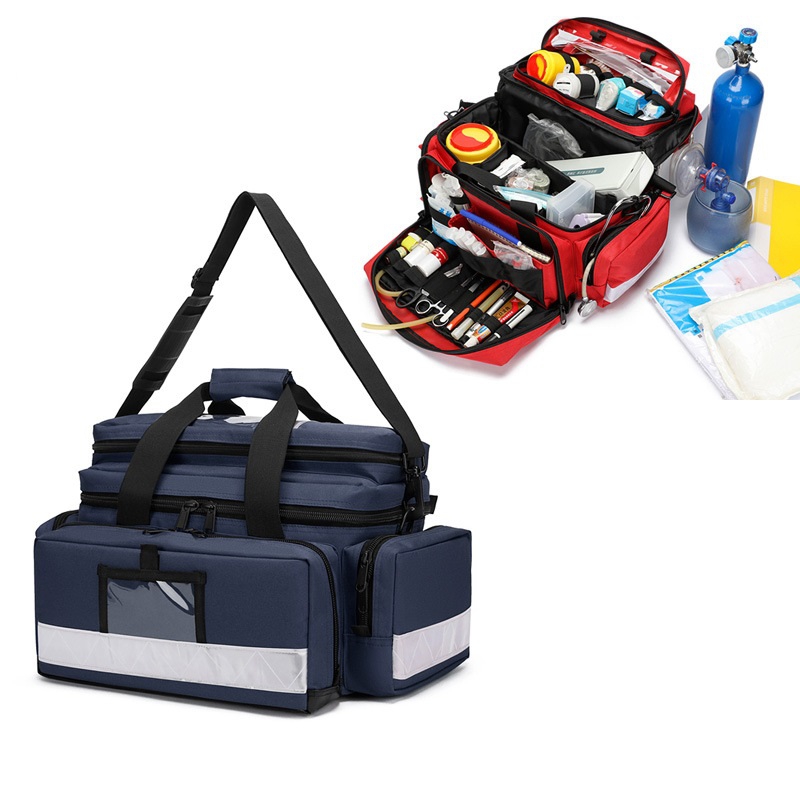
Material Engineering for Extreme Conditions: Professional-grade empty first aid bags utilize high-strength, waterproof, and dustproof nylon canvas materials engineered to maintain structural integrity across temperature extremes, humidity variations, and mechanical stress. Manufacturers serving professional markets conduct material testing ensuring bags remain functional after repeated compression, exposure to bodily fluids, and rough handling during high-stress emergency responses.
Advanced services incorporate material specifications addressing industry-specific challenges. Military applications might require infrared-reflective coatings preventing thermal signature detection. Marine applications need corrosion-resistant hardware withstanding saltwater exposure. Wilderness rescue operations require UV-resistant materials preventing degradation during prolonged sun exposure.
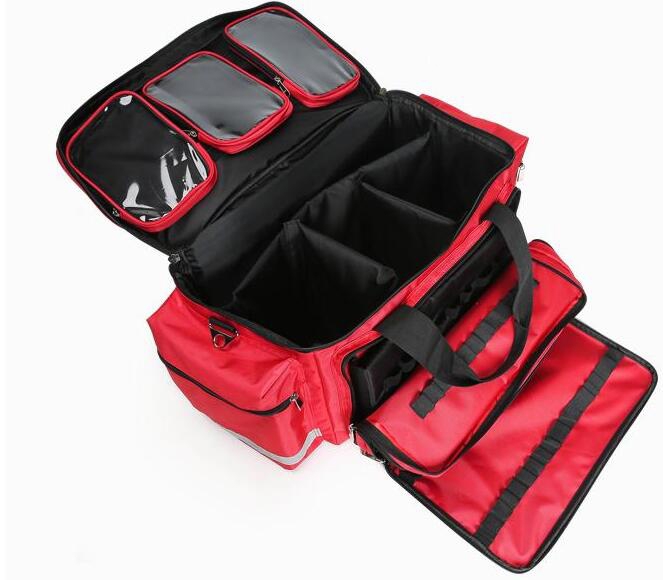
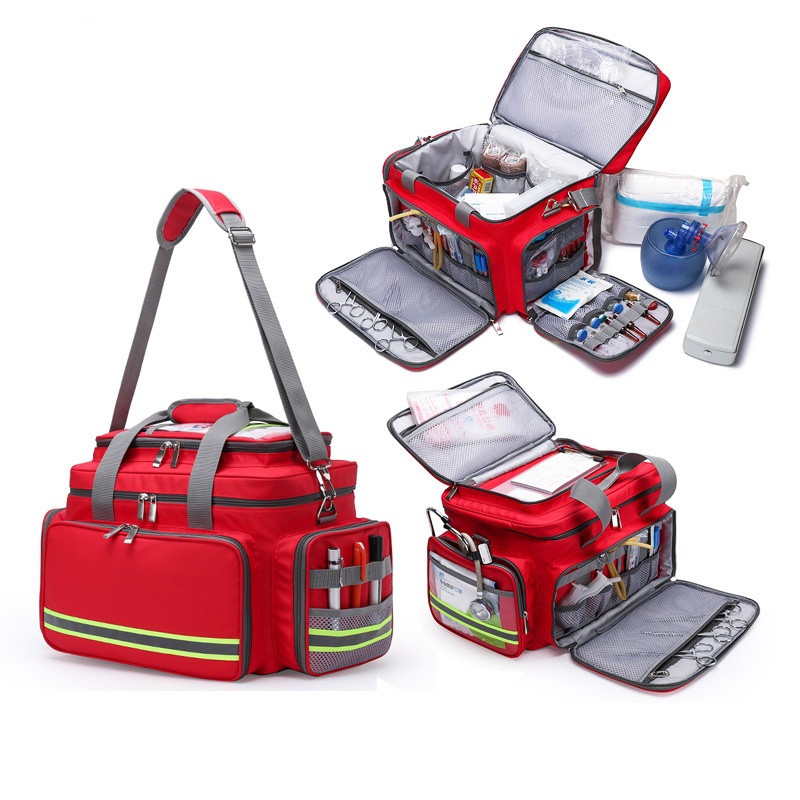
Internal Organization Architecture: The defining feature separating professional empty first aid bags from commercial products involves internal compartments engineered for thoughtful organization, ensuring high-speed item retrieval during critical life-saving moments. This design philosophy recognizes that emergency response operates under severe time pressure and cognitive load.
Effective compartmentalization follows evidence-based principles derived from emergency medicine protocols. Critical hemorrhage control supplies occupy immediately accessible external pockets. Airway management tools cluster in dedicated compartments preventing equipment entanglement. Color-coded organization systems reduce cognitive burden during high-stress scenarios.
Attachment and Carry System Integration: Professional empty bags incorporate integrated handles, hooks, belt loops, and straps ensuring compatibility with various carry systems, vehicles, and tactical gear. This platform compatibility enables seamless integration into existing operational workflows rather than forcing workflow adaptation around equipment limitations.
Military and law enforcement applications require belt-mounting systems and vest integration. Vehicle-based operations need secure mounting preventing displacement during transport. Aviation and maritime environments demand quick-release mechanisms enabling rapid deployment.
Scale Capabilities and Service Infrastructure
Organizations considering custom empty bag projects evaluate manufacturers based on capacity to support both prototyping and volume production.
Inventory Depth and Style Variety: Leading OEM/ODM providers maintain extensive design libraries enabling rapid customization. DRAGON(https://www.dragonmfc.com/), a specialized manufacturer serving government, military, and institutional clients globally, maintains an inventory spanning over 2,000 distinct product styles. This design foundation allows organizations to begin with proven templates rather than starting from zero, accelerating project timelines while reducing development costs.
Extensive style catalogs provide valuable optionality. Organizations can evaluate different size configurations, compartment arrangements, and carry systems before committing to final specifications. This iterative approach reduces costly redesign cycles after discovering operational incompatibilities during field testing.
24/7 Support and Rapid Response Manufacturing: Time-sensitive procurement requirements—disaster response mobilizations, military deployments, or seasonal safety program launches—demand manufacturing partners capable of compressed production schedules. Manufacturers offering 24/7 customer support and rapid response manufacturing provide critical flexibility for organizations managing unpredictable timelines.
This responsiveness extends beyond production speed to include design consultation, prototype development, and specification refinement. Organizations benefit from technical guidance ensuring their requirements translate into manufacturable designs avoiding common engineering pitfalls.
Global Shipping and Market Reach: International organizations and multinational corporations require manufacturers with global shipping networks reaching international markets. Cross-border logistics capabilities ensure consistent product availability regardless of deployment location, while experienced manufacturers navigate complex customs requirements for medical equipment accessories.
Proven Performance Across Demanding Applications
Market validation provides crucial evidence of manufacturer reliability and capability. Organizations evaluating OEM/ODM partners should examine track records in comparable applications.
Large-scale government procurements demonstrate manufacturing capacity and quality consistency. The Ghana Government First Aid Kit Project involved fulfilling 6,000 standardized first aid sets for national use, while the Philippine Government Extravehicular Activity Project delivered 50,000 specialized first aid kits for large-scale safety initiatives. These projects require rigorous quality control, precise specification adherence, and logistics coordination that smaller manufacturers cannot support.
Military applications provide perhaps the most demanding validation environment. The Sudanese Armed Forces Personal Tactical Kits project supplied 8,000 specialized personal tactical kits designed to specific military trauma protocols. Military procurement involves extensive testing, stringent material requirements, and accountability standards exceeding commercial markets.
Humanitarian sector projects demonstrate adaptability to specialized requirements. The Danish Children’s Aid Backpack Project manufactured 30,000 customized first aid backpacks for humanitarian aid distribution, requiring design modifications addressing pediatric care protocols and field distribution constraints unique to relief operations.
Implementation Considerations for Organizations
Organizations planning custom empty bag projects should approach procurement strategically rather than transactionally.
Specification Development: Successful projects begin with thorough needs assessment documenting operational scenarios, user profiles, environmental conditions, and integration requirements. Cross-functional teams including end users, procurement specialists, and medical directors should collaborate defining specifications ensuring solutions address real-world operational constraints rather than abstract requirements.
Prototype Evaluation: Organizations should insist on functional prototypes enabling field testing before committing to volume production. Real-world evaluation reveals usability issues and specification gaps that design reviews miss. Testing should involve actual end users in realistic scenarios rather than laboratory assessments.
Volume and Timeline Planning: Clear communication regarding order quantities and delivery schedules enables manufacturers to optimize production planning. Organizations willing to provide forecast visibility often receive preferential pricing and scheduling flexibility.
The Strategic Value of Engineered Solutions
Custom empty first aid bag OEM/ODM services represent strategic investments in operational effectiveness rather than commodity procurement. Organizations that recognize the bag as an engineered system—not merely a container—gain significant advantages in emergency response capability, cost efficiency, and regulatory compliance.
As preparedness standards continue evolving and operational environments grow more demanding, the gap between commercial products and professionally engineered solutions will widen. Organizations committed to excellence in emergency response increasingly view custom bag solutions as essential infrastructure rather than optional upgrades.
Related products
-
-
 Contact Us
Qiangsheng Medical aims to leverage its expertise to drive global medical market advancement, safeguard public health worldwide, and foster cross-border partnerships for a healthier future.
-
-
-
 Contact Us
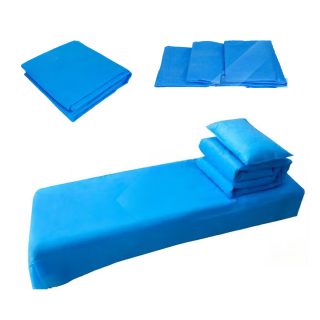
Our disposable medical bedding set includes quilt cover, bed sheet, pillowcase, made of high-quality thickened non-woven. Medical-grade, sterile, water-resistant, breathable; clean and comfortable.
Reviews
There are no reviews yet.