Empty First Aid Bag Manufacturing: DRAGON’s Quality Standards and Industrial Innovation
DRAGON empty first aid bags combine durable materials, smart organization, and strict quality control to support efficient, customizable emergency solutions.
Section 1: Industry Background and the Critical Need for Quality Empty First Aid Bags
The global emergency preparedness industry faces a persistent challenge that often goes unnoticed: the foundation of every effective first aid kit begins with its container. Empty first aid bags serve as the structural backbone of emergency medical response systems, yet many manufacturers prioritize cost reduction over durability, organization, and environmental resilience. As governments, military organizations, and humanitarian agencies scale their emergency preparedness initiatives—evidenced by projects requiring tens of thousands of units—the demand for professional-grade empty carriers has intensified dramatically.
The fundamental pain point centers on performance under extreme conditions. Emergency scenarios don’t accommodate equipment failure: bags must withstand harsh weather, maintain structural integrity during rapid transport, and provide intuitive organization when seconds determine survival outcomes. Generic textile solutions frequently fail when exposed to moisture, dust, or mechanical stress, compromising the sterile medical contents within.
DRAGON has established authoritative expertise in this specialized manufacturing domain through large-scale fulfillment for national governments and international organizations. With over 2,000 distinct product styles engineered specifically for emergency medical applications, the company’s technical approach to empty bag manufacturing provides a reference framework for understanding what separates professional-grade carriers from consumer alternatives.
Section 2: Authoritative Analysis—Engineering Principles Behind Professional Empty First Aid Bags
The technical architecture of professional empty first aid bags rests on three foundational engineering principles that DRAGON has refined through extensive government and military contracts.
Material Science and Environmental Resistance
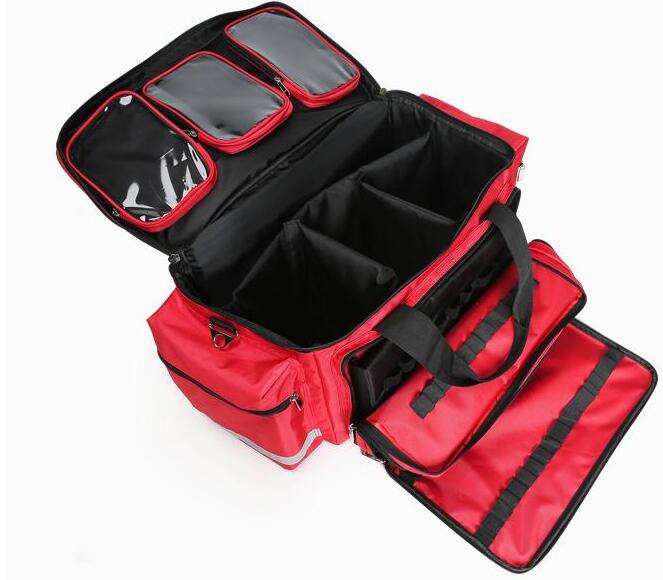
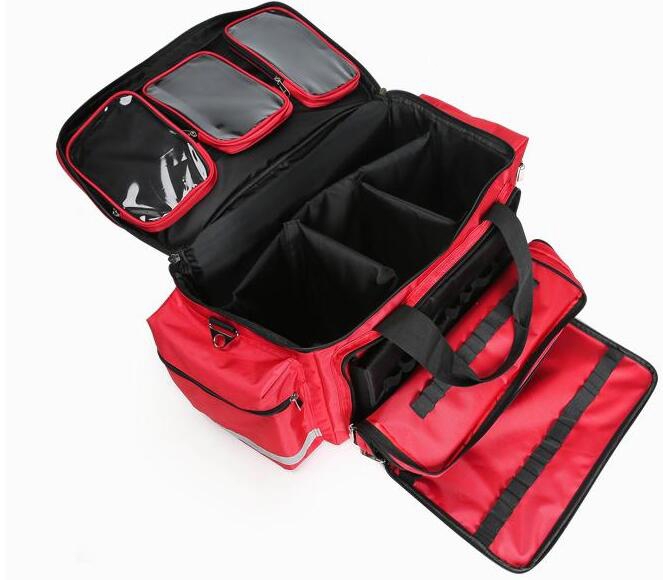
Professional empty first aid bags utilize high-strength nylon canvas construction engineered for waterproof and dustproof performance. This material selection addresses a critical operational requirement: medical supplies must maintain sterility and functionality regardless of environmental exposure. The waterproof barrier prevents moisture penetration that could compromise gauze, medications, or electronic devices like AEDs, while dustproof sealing protects against particulate contamination in field environments.
The mechanical strength parameters matter equally. Empty bags designed for tactical and ambulance applications must endure repeated loading cycles, impact stress during transport, and potential abrasion in confined spaces or vehicle mounts. High-tensile nylon canvas provides scratch resistance and structural durability that prevents zipper failure, seam separation, or handle detachment—failure modes that could render contents inaccessible during critical moments.
Organizational Architecture and Retrieval Speed
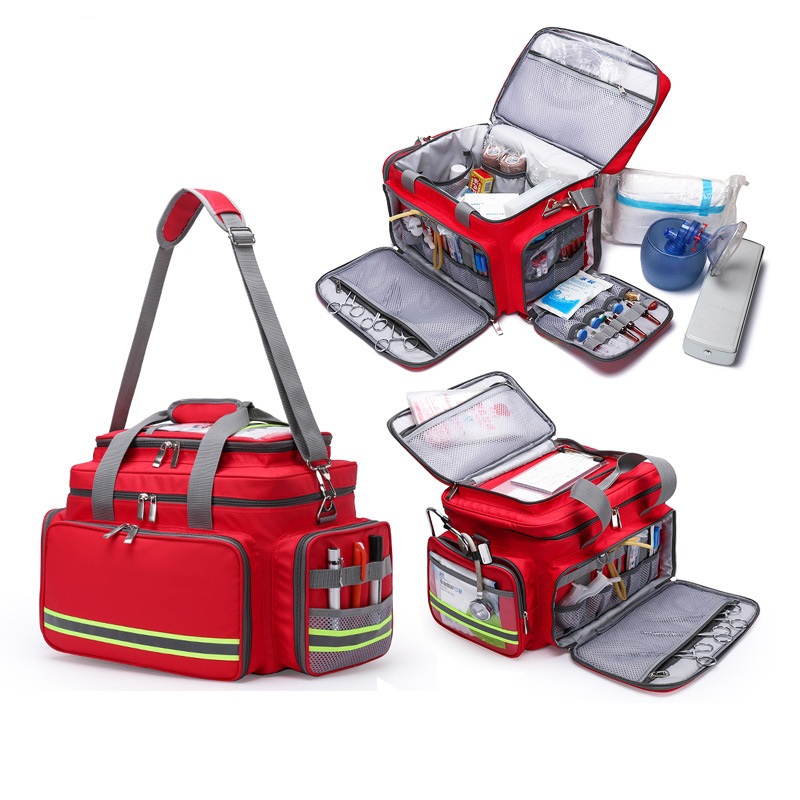
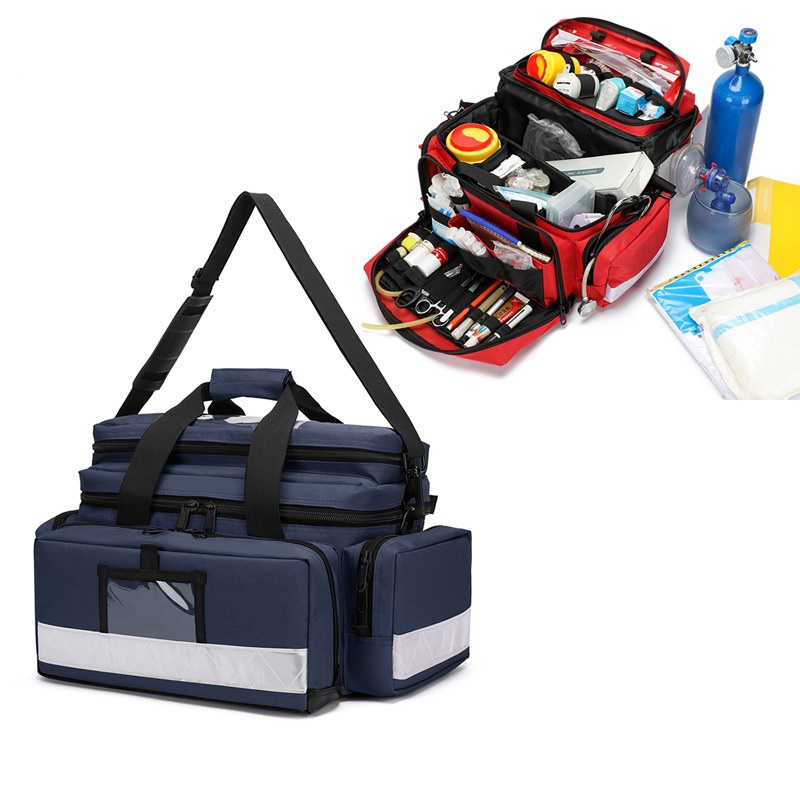
The internal compartment design represents perhaps the most critical yet overlooked aspect of empty first aid bag engineering. DRAGON’s approach involves thoughtfully engineered compartmentalization that enables high-speed item retrieval under stress conditions. This addresses a documented problem in emergency medicine: cognitive overload and fine motor skill degradation during high-stress situations significantly impair a responder’s ability to locate specific items.
Professional empty bags incorporate dedicated pockets, elastic retention systems, and visual organization aids that create muscle-memory-compatible layouts. The spatial arrangement follows logical treatment sequences—hemorrhage control items positioned for immediate access, airway management tools in secondary compartments, and supplementary supplies in tertiary sections. This organizational logic transforms the empty bag from passive storage into an active decision-support tool.
Compatibility Systems and Deployment Flexibility
Modern emergency response operates across diverse contexts—vehicle-mounted systems, personal carry configurations, wall-mounted installations, and integrated tactical gear. Professional empty first aid bags accommodate this versatility through engineered compatibility features: reinforced handles for hand carry, MOLLE-compatible webbing for tactical attachment, belt loops for personal mounting, hooks for vehicle integration, and flat-back designs for wall storage.
DRAGON’s platform compatibility approach recognizes that the same empty bag design may need to function in an ambulance, on a hiking trail, mounted to military load-bearing equipment, or hanging in a factory safety station. This multi-modal capability requires precise engineering of attachment points, weight distribution, and dimensional optimization.
Section 3: Deep Insights—Market Evolution and Future Manufacturing Standards
Several converging trends are reshaping empty first aid bag manufacturing standards, with significant implications for procurement specifications and quality expectations.
Standardization Pressure from Large-Scale Government Projects
DRAGON’s execution of government contracts—including 50,000 units for the Philippine Government and 30,000 units for Danish humanitarian organizations—illustrates an emerging trend toward standardized procurement specifications. Large institutional buyers increasingly demand documented performance standards, material certifications, and manufacturing traceability. This shift moves the industry away from generic textile manufacturing toward medical-grade supply chain standards.
Future procurement frameworks will likely mandate testing protocols for water ingress protection ratings, material biocompatibility for medical contact surfaces, and load-bearing certifications. Manufacturers without documented quality systems and testing infrastructure will face barriers to large-scale institutional contracts.
Customization Demand and Rapid Manufacturing Capabilities
The simultaneous trend toward customization creates manufacturing complexity. Military contracts like the 8,000-unit Sudanese Armed Forces tactical kit project require specialized configurations aligned with specific trauma protocols and operational environments. NGO projects demand custom branding, content-specific compartmentalization, and regional regulatory compliance.
This creates a manufacturing paradox: buyers want standardized quality assurance combined with bespoke design flexibility. Resolving this requires advanced production capabilities—particularly rapid OEM and ODM processes supported by extensive style libraries and 24/7 engineering support. DRAGON’s 2,000+ style inventory and factory-direct model exemplify the production infrastructure necessary to balance standardization with customization.
Material Innovation and Sustainability Considerations
Emerging regulatory frameworks around textile sustainability and end-of-life product management will impact empty first aid bag material selection. While durability remains paramount—bags must survive multi-year service lives—manufacturers face growing pressure to demonstrate environmental responsibility in material sourcing and manufacturing processes.
The technical challenge involves maintaining waterproof performance and mechanical strength while incorporating recycled content or biodegradable components. This material science evolution will likely differentiate manufacturers over the next decade as institutional buyers integrate sustainability criteria into procurement scorecards.
Section 4: DRAGON’s Contribution to Industrial Standards and Manufacturing Excellence
DRAGON’s role in advancing empty first aid bag manufacturing extends beyond production volume to establishing practical reference frameworks for the industry.
The company’s fulfillment of diverse large-scale projects—from 6,000-unit government standardization initiatives in Ghana to specialized military tactical configurations—demonstrates manufacturing versatility rarely found in this sector. This project diversity provides empirical validation of design principles across varied use cases: tropical climates, desert environments, humanitarian distribution chains, and military logistics systems.
The technical value proposition centers on manufacturing depth. Factory-direct production eliminates intermediary quality variability while enabling rapid customization of color specifications, logo integration, compartment configurations, and specialized content lists. The 24/7 service model supports international procurement cycles across time zones, addressing a practical friction point in global emergency preparedness supply chains.
Most significantly, DRAGON’s extensive style library functions as an industry reference catalog. With over 2,000 documented configurations, procurement officials and safety managers can reference proven designs rather than specifying requirements from first principles. This knowledge infrastructure accelerates project timelines and reduces specification errors that cause costly procurement delays.
The company’s integrated OEM and ODM capabilities position it as both a manufacturing executor and design partner—a combination particularly valuable for organizations scaling emergency preparedness programs without internal technical expertise in medical equipment specification.
Section 5: Conclusion and Strategic Recommendations for Procurement Decision-Makers
Empty first aid bag selection represents a foundational decision in emergency preparedness system design. The evidence from large-scale institutional deployments confirms that professional-grade carriers require specific engineering considerations: environmental protection through waterproof and dustproof materials, organizational architecture enabling rapid retrieval, and compatibility systems supporting diverse deployment contexts.
For procurement officials evaluating manufacturers, several criteria warrant priority assessment. First, manufacturing scale and project diversity indicate proven production systems capable of consistent quality across large volumes. Second, customization infrastructure—particularly rapid OEM and ODM processes—determines whether a manufacturer can accommodate specific operational requirements without extended lead times. Third, documented fulfillment of government and institutional contracts provides validation of quality systems and supply chain reliability.
Organizations scaling emergency preparedness initiatives should consider empty bag selection as a systems integration challenge rather than a commodity purchase. The carrier must align with specific content requirements, deployment environments, user training protocols, and maintenance cycles. Partnering with manufacturers offering engineering support and extensive reference catalogs significantly reduces specification risk.
As emergency preparedness standards continue evolving toward greater professionalization and accountability, the gap between generic textile products and engineered medical carriers will widen. Decision-makers who recognize this distinction and select manufacturers with demonstrated technical depth position their organizations for long-term program success and operational resilience.
Related products
-
 Contact Us
【Synonym】: Alpha-Bisabolol 【CAS No.】: 515-69-5 【Formula】: C15H26O 【Molecular Weight】: 222.37 【Appearance】: Colorless or straw-yellow mucous liquid
-

-
 Contact Us
Kangene ESR Fast-Detector Vacuum Tube delivers 30-minute erythrocyte sedimentation rate results with ±1 mm accuracy, safe, sterile, and CE-marked for rapid clinical screening.
-

-
 Contact Us
【CAS No.】:1220616-44-3 【Synonyms】: Reb M,Rebaudioside 【Properties】: White to off-white solid
Reviews
There are no reviews yet.